
Look's 795 Blade RS put through Cyclingnews wind tunnel test
Cyclingnews' CN Labs team examined the aerodynamics of Look's new 795 Blade RS, a bike whose conventional looks hide an aero-focused design built around a narrow front end.
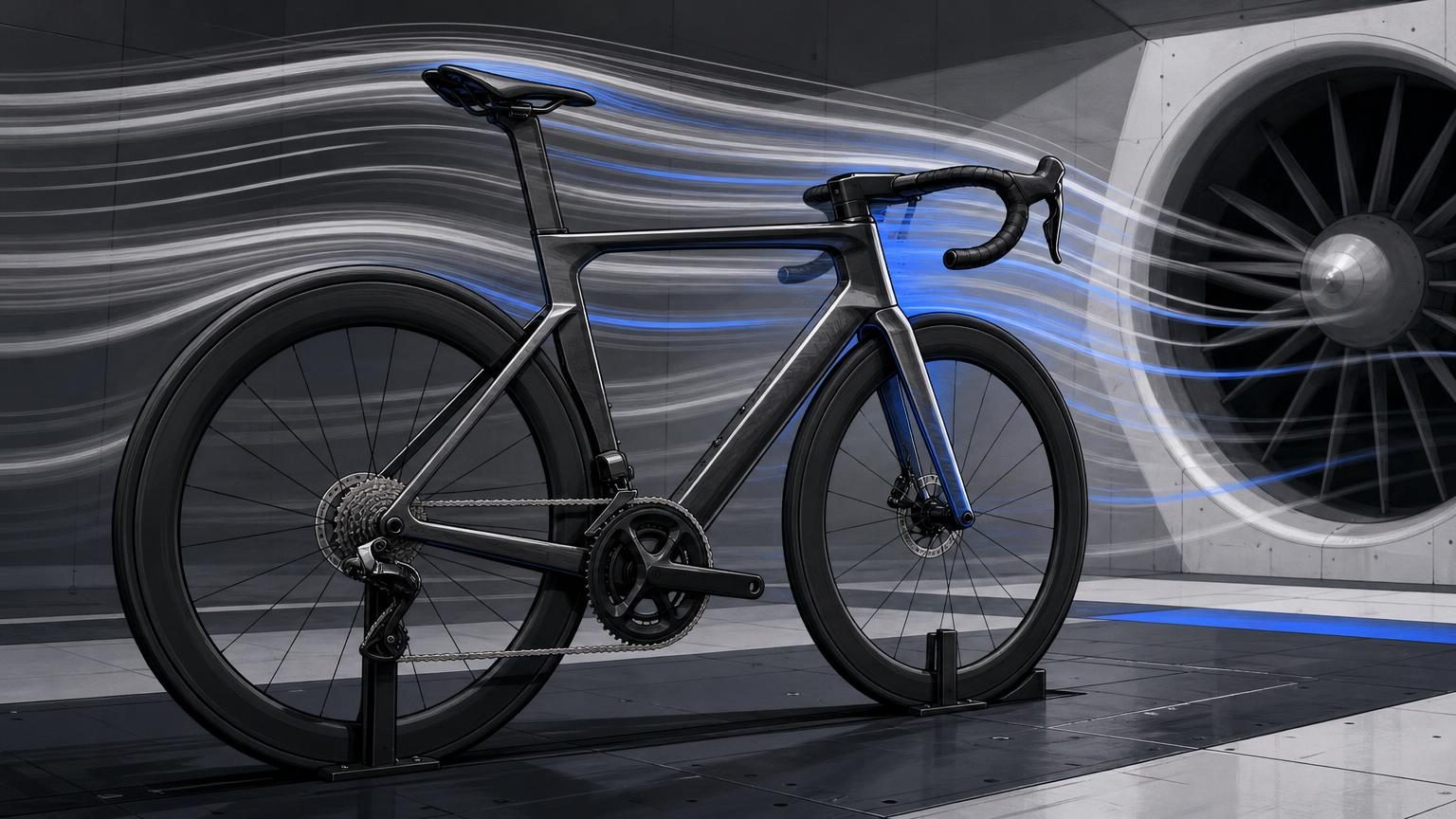
Cyclingnews' CN Labs testing team has put the Look 795 Blade RS through wind tunnel assessment, examining a bike that looks far less extreme than many of the aero machines now on the market.
Unlike deep-profiled rivals from brands such as Factor and Van Rysel, the 795 Blade RS relies on relatively slim tube shapes with squared-off ends rather than sharp angles or flared sections, according to Cyclingnews.
The frame does share one trait with some of its most aerodynamically focused competitors: a narrow front-end profile, a feature also pursued on the Factor ONE and the Specialized Tarmac SL9, where the leading edge of the bike is treated as central to overall aerodynamic performance.
Look has not fitted dedicated aero bottle cages of the kind found on the ENVE Melee V2 or Trek Madone. Instead, Cyclingnews reports that bottle boss placement and tube shaping are intended to reduce the aerodynamic penalty typically caused by fitting a standard 500ml round bottle, with a Kamm-tail design at the rear of the tubes helping to shroud the bottles.
The bike's head tube is tapered to keep the front end narrow. Look states tyre clearance at 34mm and claims a race-ready weight of 7kg, though Cyclingnews notes the brand has not specified exactly which components are included in that figure.
For the wind tunnel work, Cyclingnews tested the bike in standard configuration, with components and position matched as closely as possible to other bikes in its testing series, before repeating the process with a rider present to reflect real-world conditions.
A control wheelset of Enve SES 4.5 wheels fitted with 28mm Continental GP5000 S TR tyres was used so the frame, fork and components could be judged independently of a bike's standard wheel and tyre package, Cyclingnews said. The bike pictured for testing came fitted with a Scope Artech 6 wheelset.
Testing was carried out across yaw angles of -15, -10, -5, 0, 5, 10 and 15 degrees to gauge crosswind behaviour, at a speed of 40km/h, which Cyclingnews chose as representative of a faster club ride or amateur time trial rather than the higher speeds seen in elite road racing. Bike-only runs collected ten seconds of data at each yaw angle to limit variance in the results.