
How an engineer's hobby gave golf balls their dimples
An amateur golfer and lens-making engineer named William Taylor solved a century-old flight problem, patenting the dimpled golf ball design still used today.
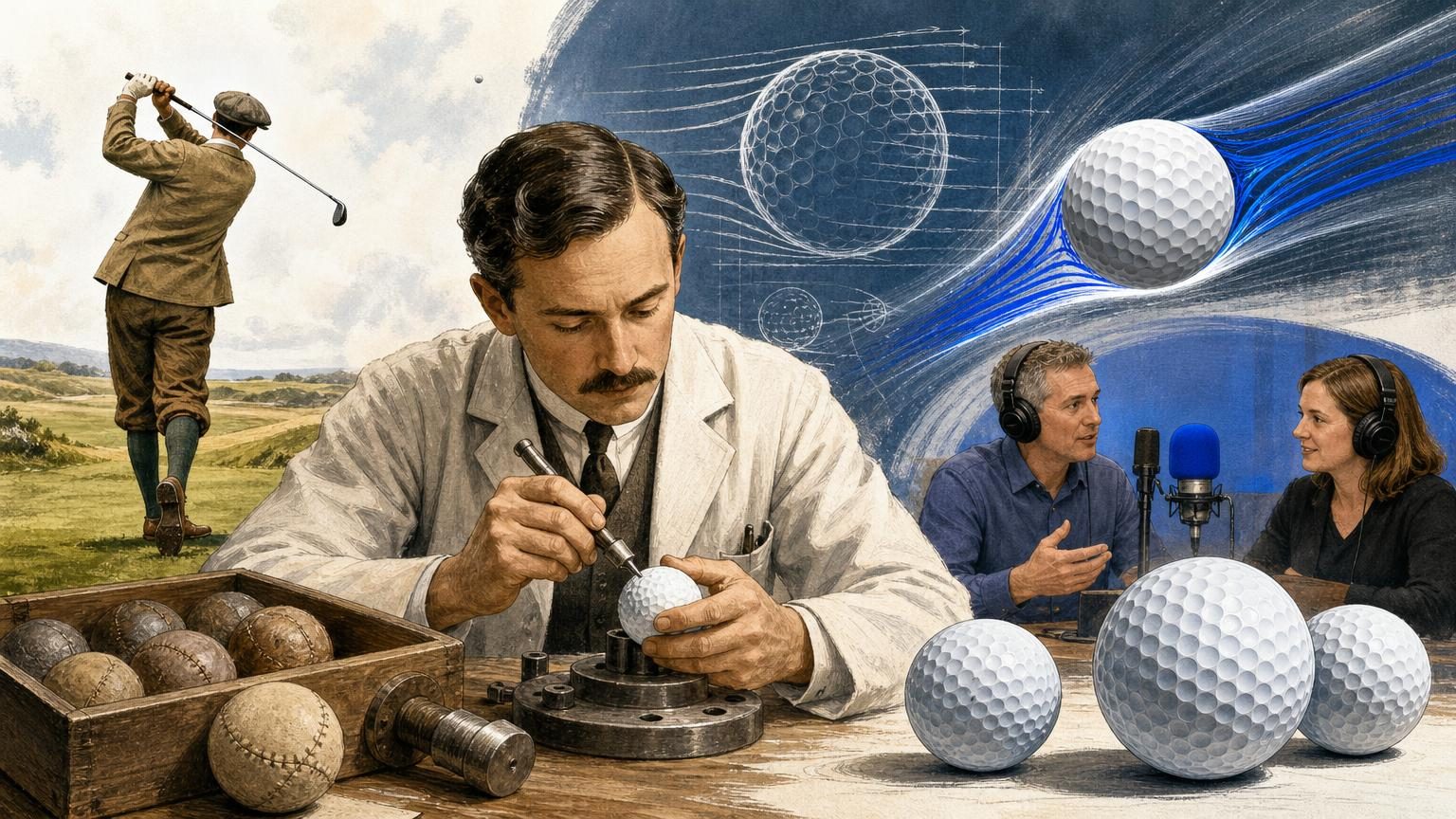
Golf balls were once perfectly smooth, until players noticed that the dents and chips they picked up through use made them fly straighter and further, according to BBC Golf.
Some golfers took to deliberately hammering grooves into their balls once they realised rough surfaces improved performance, even though nobody fully understood why.
That changed with William Taylor, an engineer who co-founded the lens-making firm Taylor Hobson in Leicester in 1886 with his brother, and who took up golf as a way to unwind from work.
Sophie Edwards, of More Than Just a Gift at Narborough Hall, where Taylor carried out his experiments, told the BBC that his engineering instincts overtook his leisure pursuit. "Golf was supposed to be the relaxing hobby, but then of course he turned it into an engineering problem. I suppose it's just that kind of mind that he couldn't resist," she said.
Gavin Bottrell, who makes replicas of historic golf balls and runs Timewarp Golf in Warwickshire, explained that golf balls had for centuries been featheries, made of leather stitched together and stuffed with feathers, before gutta-percha, a natural tree sap, became the material of choice from the mid-19th century.
Golfers at the time knew instinctively that marked surfaces helped the ball fly better, but, as Bottrell put it, "they didn't know why".
Taylor Hobson said its founder built a golf ball driving machine, a club swinging on an inclined axis under a weight, which tested large numbers of balls with different dimple patterns and measured how far each one flew.
Edwards said Taylor also constructed a smoke chamber in a barn at the Grade II listed Narborough Hall to study airflow over differently patterned ball surfaces, using a glass-fronted chamber through which smoke was blown. "It was really very high tech at the time and that's what he did at Narborough Hall," she said.
Taylor filed his patent application, covering both the dimpled design and the testing machine, with the United States Patent Office in 1906, and it was granted in 1908, according to the Royal Society.
The patent stated the aim was to achieve "a sustained hanging flight giving a flat trajectory with a slight rising tendency". Golf equipment maker Titleist says dimples work by reducing drag on the ball in flight.
Bottrell noted Taylor's original dimples were larger than those used today, with balls only beginning to resemble modern designs from around the 1930s.
The dimpled cover emerged around the same time as Coburn Haskell's 1898 invention of a rubber-wound ball with a solid core, which Bottrell called "a massive revolution" in its own right.
Bottrell said the leading drivers of the late 19th century managed around 200 yards, but by 1910, thanks to the combination of the Haskell ball and Taylor's dimple pattern, professionals were reaching roughly 270 yards.
Edwards said many other surface patterns were tried over the years, but Taylor's design endured. "There were so many other patterns that were tried, but the dimples that Taylor developed were the ones that actually stood the test of time - and became the standard that we wouldn't imagine any golf balls in any other way now," she said.