
Rotational impact test for cycling helmets still without agreed pass mark two years on
Cyclingnews reports that despite a rotational impact test being published in 2024, no European pass mark has been agreed, leaving helmet makers to pursue their own safety solutions.
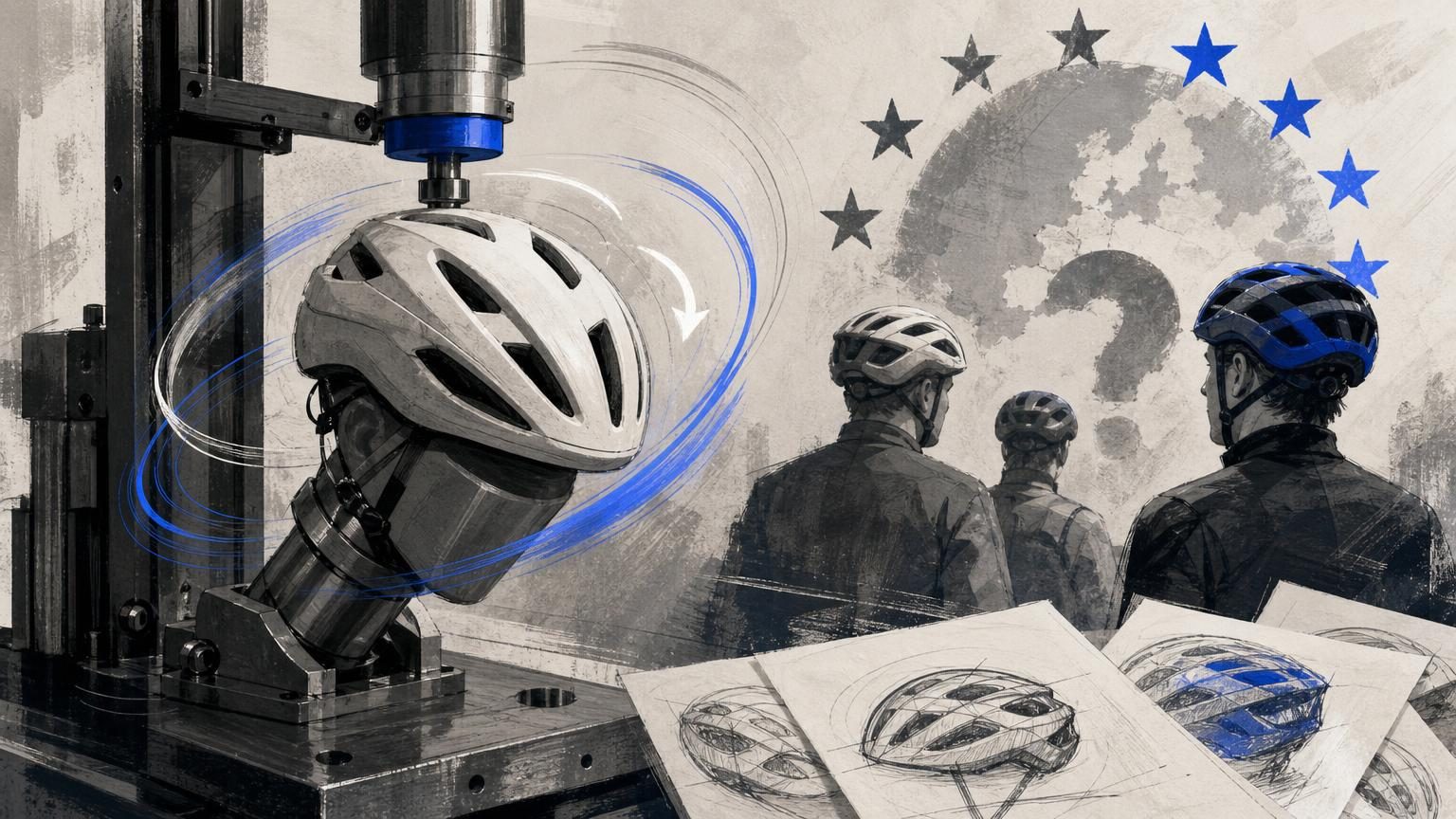
Cycling helmets sold across Europe remain certified only against straight-on impacts, under a standard that has not changed since 2012, according to Cyclingnews.
A dedicated test for rotational impacts was published in 2024, but the committee responsible for setting a pass mark has still not agreed whether, or how, to require it, the outlet reported.
The gap matters because research from Imperial College London, published in 2023, found that the majority of brain injuries suffered by cyclists in real-world crashes stem from rotational forces, produced when a rider's head meets the ground at an angle rather than square on. That twisting motion stretches and shears the brain, damaging nerve fibres and blood vessels and raising the risk of concussion or more severe traumatic brain injury.
In the absence of a mandatory standard, manufacturers have developed their own approaches. Mips, whose yellow sticker appears on helmets throughout the professional peloton, fits a slip layer between a helmet's inner padding and outer shell to let the helmet move independently of the head on impact.
Newer systems place the technology outside the shell instead. The Release Layer System, known as RLS, bonds panels to a helmet's outer surface on polycarbonate bearings that absorb energy and detach under a significant impact, according to the company. RLS told Cyclingnews its technology lowers the risk of concussion from 64% to 9% compared with a standard road helmet.
"Because the technology is on the outside, the moment you make an impact, the technology is able to instantaneously work rather than being in those microseconds absorbed and then having to do the work on the inside," said James Cook, chief executive of RLS, which grew out of the helmet brand HEXR that he co-founded.
Cook said bearing-based systems cope better than some alternatives when impact forces are high. "That's where actually a bearing solution is really good because bearings have been used for high pressure," he said, adding that the panels are built to withstand everyday knocks and only separate under a serious impact.
Other manufacturers broadly agree that external solutions have merit. "Reducing friction on the outside is a better idea than reducing it on the inside," said Alessandro Cernicchi, research and development director at Kask. Max Strandwitz, chief executive of Mips, said an external location offers more surface area to redirect energy through greater movement.
Mips itself explored an external concept called Impact Shield in 2017, but Strandwitz said the company grew wary of releasing it. "We were a little bit reluctant to release the Impact Shield because as soon as you have solutions on the outside of the helmet, they become very sensitive. If you drop it or if you bump into something, all of a sudden, the technology is out," he said.